Pages

Friday, 30 March 2018

What is Success?

As the concept of expectations and definitions of success continue to rattle around my mind, the question that propels itself to the top with the most force is What's wrong with a white, middle class mother having white, middle class expectations for her children?

I have to say: nothing.


Yesterday I was giving thought to the differences of expectations of expectations I have for my own kids. People have often mistakenly accused me of pushing my kids, when in fact all I do is listen to their interests and support them the best I can. This usually means they get the most support in literacy and inquiry because these are my two strengths. Many of the things they are interested in are typical of white, middle-class because this is our culture. So why do I feel like this is wrong?

I came to see that it's not. My family is white, we are middle class. I was feeling like a bad guy for having and perpetuating this culture until I took the time to acknowledge that this is our culture and our heritage.

And yet my children are also interested in kapa haka and learning te Reo, so we have te Reo books at home. They're interested in bush craft and Maori knowledge of the bush is far superior to my own.

Being white and having a white, middle-class culture isn't wrong or bad. It's just different.

What is wrong is when we try to purport that other people are failures for enjoying success in their culture. It's wrong to ignore individuality and force an identity onto people. It would be wrong of me to tell my children they should not be interested in learning te Reo. It would be a shallow understanding and knowledge of bush craft we'd have it we only used a white botanical construct. We need Maori voice - the Waitakere rahui is an excellent example of this. They care about our natural resources. They are about our history. We're lucky we have Maori people who are holding onto their Maoridom - all over the world we see indigenous peoples making a far better job of being kaitiaki of the land than white people. They know the land and how to respect it in ways I - for one - do not. If nothing else, it makes sense for our survival to make sure Maori voice is heard.

My husband was challenging me last night, asking what if our #3 wanted to be a race car driver? My tummy tightened and my jaw clenched at that. It's not something I want my intelligent little girl to do.


As we've been walking around MOTAT today, my husband takes every opportunity to challenge my thinking and my perceptions. The Dig It exhibition is on this weekend, so there are construction-themed activities everywhere. "You should be a stop-go girl", he said to #1, with a swift swat from me. "She'll earn lots of money", he said. "You could be a digger driver and ear lots of money" he said to another - again with another swift flick from me.


See, there's nothing wrong with money. Nothing wrong with having money or earning money. With money you can do a lot of good and help a lot of people. But money isn't my measure of success. Maybe that's because I was raised in a white middle class family. I read an article a while ago that suggested people who were raised in white middle class families accounted for a significant proportion of conceptual degrees - Arts degrees and the like. The reasoning the writer put forward was that people from these families weren't in need of anything so they didn't study skills-based qualifications to learn how to do something specific. Building, mechanics, engineering for example. They studied thinkgs that were interesting to them because they weren't driven by an economic need. So if my definition of success isn't an economic one, and it's not necessarily an academic one, then what is it?

I think my definition of success has more to do with an intrinsic sense of purpose. My #1 child has a dream of being a scientist, so if she wound up being a digger driver I don't think she'd feel successful. She may enjoy learning how to drive a digger, and she may enjoy using one on the weekends to dig holes to build gardents, but I don't think she'd feel successful. Not unless she was researching the physics of the machines and innovating a green, sustainable replacement. On teh other hand, my #2 child was stoked to be driving a digger today, and maybe that's something that would give him a feeling of success and satisfaction. On the other hand, it may not because he has the goal of becoming a nurse.

Some would see - and do see - teachers and nurses as being unsuccessful because we get paid so little. It's certainly not a career you get into if you're looking for a 6-figure salary right off the bat (although that would be nice, thanks government). Yet teaching leaves me immensely satisfied. I see changes in people's skills and thinking everyday. I see young people journey from being children to young adults. I'm home with my kids in the holidays and after school. I have a consistent flow of learning available to me. I can push boundaries and find new ways to engage teenagers in their learning - and their world. I never have the same day twice.

So I feel that my definition of success actually still remains. I will be a successful teacher if every students (and colleague) feels valued and supported to explore the things that matter most to them. That means my Maori students feel that their culture and their stories are valuable and valued. My musical students feel supported to express their teenage angst in their writing. My dyslexics feel confident and competent sharing their understanding using pictures and audio rather than writing everything down if that's what they need to do.


And maybe the Maori students just need me to stand out of their way. Maybe I present them with a range of texts to study and bring in Matua or Whaea to help them unpack the Maori texts in a genuine way. Maybe I need to change my pathway to success. Maybe then I can authentically say I'm providing a space that allows Maori to achieve AS Maori.


Thursday, 29 March 2018

What REALLY makes a CoL a Kahui Ako?

Teacher Only Day - Whiriatetangata Kahui Ako Day #1

Storified session Tweets


Challenging.
Disruptive.
Mental Assent.

Words to describe my experience of today's teacher only day - the first for the Whiriatetangata Kahui Ako.

I say every child deserves an equal opportunity.
I say success looks different for everyone.
I can give mental assent to cultural sustainability and to equity; to having a different version of success for everyone - but do I really mean it? I had a great couple of colleagues press me on this today - and found that as much as I espouse these ideas, my underlying prejudice says otherwise. I say these things, but what I really mean is:

You can have equal opportunity - but only if you agree with what I think is important and valuable.
You can have your version of success - and I can look down on you and celebrate your success from a position of superiority because my children have true success.

I was challenged: What does success for my children look like to me?
Competent and capable to do what it is they want to do.
But what about kindness? Happiness?
Kind people can get used as doormats, I'd rather they were assertive.
Happiness comes from being competent and capable.
But does it really?
Well, I certainly feel happier now that I don't feel incompetent and incapable every day of the week.
What does success for your children look like for you?
My #1 is academically very capable and aspires to be an innovative and inventive scientist. My #2 was given a 1% chance of life, and now he's beaten the odds and progressing. #3 is flying along enjoying learning and enjoying people, while #4 is happy cruising, exploring, and just being in the world.

If I'm truly honest - I struggle daily with the fact that my #4 just doesn't seem as motivated to learn as the others, and worry that she's not as smart as the others.

So what's my measure of success for my children? I can't say it's academic success, because I don't expect #2 to reach any lofty academic goals. He aspires to be a nurse, and I feel that a health care assistant might be a more appropriate goal for him. Yet, academic success is what I expect from my girls and worry when my #4 aspires to be a frog and a bulldozer and barbie, and Hulksmash...

What I can say is that I have a different measure for success for each child. I can say that I have never pushed my kids into being something or doing something - I've just supported in the best way that I can. When that has meant bringing home friends who are cleverer in Maths than I am to play maths games with my 3-4 year old because that was what she was loving, and I have no idea how to do that, that's what's happened. When that's meant searching high and low to find reading material that is suitable for my bookwormy children who have a higher reading age than what emotionally their minds can handle, that's what's happened.

Perhaps it's easier in my family because we're all the same culture, colour, ethnicity, background. I'm sharing with my kids my values and beliefs because that's my job as a parent.

So what's my job as a teacher?

To be culturally responsive?
But that doesn't just mean stick Maori labels on things and tick the box. I was heading more in the culturally sustainable way when I had my te Reo learning goals up on my whiteboard and my Maori ako gave me feedback on my learning.
It also doesn't mean chuck in some Maori authors.
I've never agreed with the idea of focusing on Maori (or anyone) as targeted, priority learners, because I've always fought for treating every student as an individual, and finding ways for the student to succeed. My late high school principal said "if the student isn't learning then the teacher isn't teaching" and I took that to heart. So if my students are not achieving the success they deserve, then what is it that's missing?

When everyone can achieve success in a way that is meaningful for them - is that when a Community of Learning can authentically call itself a Kahui Ako?


Sunday, 25 February 2018

A Rose by Any Other Name...

Would still smell as sweet, wouldn't it?

My brother's mother-in-law asked me last week what the difference was between teaching at the two different schools. Week 4 at HPSS has had me reflecting on the differences in teaching practise between what I was doing at my last school and what I do now. Not much is different - yet. However, I have taken mental note of the differences in teaching, and this is what I've come up with.

Two Teachers and Subjects in Some Classes

The most obvious difference are the modules. These are the classes I teach with another teacher from another curriculum area. I teach two of these - one is called Kakahu and the other is called DBAD101. Both of these courses run for a semester.

Kakahu
Kakahu is a foundation module which means the students are years 9 and 10. I co-teach this module with a technology teacher and together we're exploring fashion. We sit together for 80 minutes every Friday morning and plan our next week.

This week we are using reading and drawing skills to interpret characterization. We'll look at characters and interpret their personalities. We'll look at the opening clip of Inside Out and look at how characters and emotions are visualised. We'll read a text and highlight character descriptions. Based on the interpretations of characters, they'll use kiki babou and color theories to create symbols for characters. They will then use these symbols in creating a storyboard to visualize a short story that we'll annotate and unpack together.

This is different to teaching my year 9 classes and my year 10 classes on my own. While I still had the reading skills happening, and I still tried to get students to visualize the symbols, I never managed to get the quality of work out of students that my co-teacher does. She has the subject-specific knowledge which empowers her to get great visual results out of the students.

A section of our planning document where we can see who is responsible for what for our up-coming classes.


DBAD101
As with Kakahu, this is a one-semester course. It's year 11 / Level 1 NCEA. It's a combo of English and PE with a focus on leadership, communication, and conflict. We have chosen texts that look at these concepts, and I have asked the students to find a novel that has these ideas in them as well.

We have been looking at the concepts of leadership and communication, and as we have done so, we have taken them out to the PE field and had a go at using these skills in practical situations. This is something I was always keen on doing, but didn't know how to pull it off. Having a PE teacher in every class means I always have someone to bounce off.

Having two teachers in the class is great in other ways too - when kids who are working hard and need my time to really get the concepts, there is another teacher available for behaviour management, or to float and talk to the other students and explore concepts with.

A section of our planning doc showing how we are going to explore the film in a practical way through PE


Flexible, Responsive, Blended Learning

This kind of practise all teachers strive for. We all want to ensure the success of all our students. I've always had playdough in my room. In recent years I've had maker-spaces with equipment to create with. Colored paper, glue, scissors... I've spent hours and hours learning how to teach with technology, so that devices weren't just word processor, but powerful learning tools. Difficulties arose with students not wanting to bring their devices to school. Being in an environment where devices, Universal Design for Learning strategies, and flexibility is normal makes teaching in this way much much easier.

My plan for my Level 2 class on Monday (2x80 minute blocks) has space for this.
Romeo and Juliet Act Two Activities

Flexibility also comes in spaces that I can use. I have taught in small, glass-encased meeting rooms, large open spaces, the auditorium, the tennis courts, the library, a social space, a tech room... All in two weeks. I currently have a lot of flexibility in where my class is depending on what we're doing.

The online classrooms that facilitate flexible, autonomous learning


Structured Tools Enable Flexibility

This has been instrumental to my feeling of calm in teaching. I have always strived for flexible, differentiated learning, and have tried to use assessment for learning techniques. I kept looking to find the best way, and never managed to get or create what I wanted. One of the biggest blessings in coming to HPSS is that the DP in charge of Curriculum and Learning has spent the time with her team researching and deconstructing every facet of the New Zealand Curriulum and the NCEA assessment documents. This has allowed her, with her team, to generate a solid foundation of tools, vocabulary, and practices that are versatile and cover every learning area. I feel freed up to use the tools, design my lessons, and know that the students will understand.

By looking at the learning matrix for the school and combining it with the assessment rubric for the work that I'm doing, I get clear and streamlined learning objectives that clarify what learning activities I need to find or create.


Romeo's and Juliet's Coming of Age Journey

So What is the Difference?

In the end, the differences come down to:
Consistent, visible learning frameworks
Consistent expectations for autonomous learning
Consistent expectation that learning is grounded with a real-life application, and
Consistent expectation that the students can get out into the community or engage the community and use their skills.


Thursday, 15 February 2018

Getting my Teach on

Week 3.

This has been my first week of teaching at HPSS, and so far - I love it! Dad asked me how teenagers were supposed to focus for 80 minutes, or 160 minutes, and the reality is that they do. We're not asking them to do the same thing for the entire lesson - that would be mind-numbingly boring. We're exploring the content using a plethora of learning activities.

On Tuesday I only saw two classes - my foundation class (Year 9 and 10 Technology and English) and my Year 13 Literary Theory class. I saw each of them for 160 minutes - one 80 session before morning tea or lunch, and one 80 minute session afterwards. For my year 13s, it meant I was delivering a week's worth of teaching in an afternoon. They were able to produce a piece of writing for me that showed me their current skills and where we could focus on developing further. I was really impressed by these students' writing ability. That's something that I want to keep a close eye on, because the way they have developed their writing is really sophisticated.


What I love about the English and technology combo with my foundation students is that it's a co-taught module. So many cool things happening. I would be teaching with direct English instruction and turn to write the instructions on the whiteboard only to find them already there - my co-teacher had written them for me. As we go through things, we're looking at the same notion of dressing through similar lenses - what does it tell us about the person, about the history, about the culture? And as we research dress, we find out more about these things which brings amazing depth to our understanding of the texts and inspiration to our design concepts for clothing.

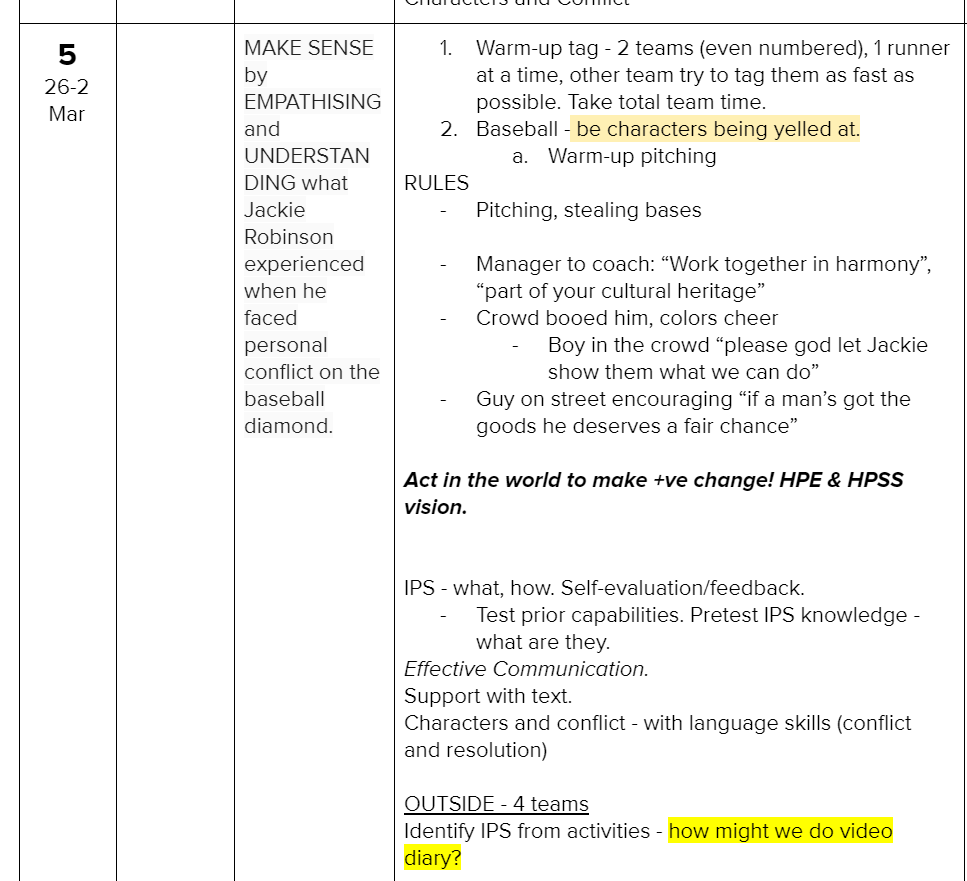
What's also really exciting is how my English and PE module brings great depth of understanding. We're looking at leadership, communication, and conflict. After starting with some ground work exploring the contexts of our module, we started analyzing leadership, conflict, and communication in the film 42. Careful planning and detailed communication between my co-teacher and I had us choosing a film that is critically viable and fits the focusses of the PE curriculum. After exploring these concepts in the opening of the film, we're going to explore them physically through games and activities on the field on Monday. More depth of understanding through physical engagement! So excited!


My level 2 class looks at the idea of coming of age. Initially I struggled to find a way through this that wasn't dry and boring. Teenager-struggle-makes adult decision. And repeat. All year long? Hmmm. When we started talking about it in class, we found ourselves a way forward - exploring the teenage brain and what it goes through, and how neurodevelopment influences characters in different ways in different texts. Then, looking at coming of age stories through the ages, examining how societal expectations change and influence the teenagers' experiences.


I'm really enjoying that I'm not teaching to an assessment. I'm teaching a topic, I'm including the skills, the students are compiling bodies of resources, and when we're ready, we'll craft the resources into assessments. That doesn't mean we're phlegmatic about the work though -already this week my level 2s have analysed a short story, exploring ideas and written a literary response, and my L3s have written an essay that can go into their portfolio for further crafting.

Dad also commented on the students calling me by my first name, and whether that allowed them to show respect. Modern teenagers don't give people respect because of their title. Modern teenagers aren't impressed or influenced by title. What matters most is mutual respect built up through relationships.

The use of devices is something that dad is often concerned about. But can I tell you a secret? They're not used 100% of the time. All students have laptops and they all come to school everyday. They are used - the parents' investment is not wasted. They access Google classroom, teaching notes, and they write responses there. But devices are only one tool. We've done mix and match, drawing, reading aloud, class discussion, group discussions... The device is only one tool in our arsenal as teachers. I've always seen devices as a window - what we can see through them is as important as what we write on them.


Tuesday, 13 February 2018

Camp 2018

I love camp. I always have, so it was a privilege to experience a camp held at a different place, led by a different group of people. One of the last things I did at Long Bay was go to year 9 camp, so it's kinda cool that camp is one of the first things I'm doing here too. I found myself looking for Jeff a few times though, until I remembered who I was out with!

Camp was a day and half, with the focus on continuing to connect with my hublings. I love the philosophy, and had to confront my imbalanced tendency to be more of a doer than a talker. I like getting out and doing things, so the periods of time where we were sitting chatting I quickly found myself wondering what to do next. "What do I talk about now?!"

I know, I know, time spent chatting together is important! It's a skill that I can't neglect anymore; I'm going to have to practise it!

Due to a flooded campsite out at Piha Mill, we had two communities of students out at Carey Park instead of one. This led to needing an adapted programme which the EOTC team managed epically well.

For my community, Waiarohia, camp went like this:

Thursday
  • Left school at 9am, taking double-decker Ritchies buses to Carey Park Christian Camp in Henderson Valley.
  • On arrival, students congregated for safety briefing and morning tea. Staff also attended the safety briefing before being taken for safety training on the activities we were to run.
  • Hub activities on the field included name games and icebreakers.
  • Hub Relay was the first indication that as a hub we have plenty of work to do on communication! We managed to complete three tasks - out of about seven. I haven't decided if we had too many chiefs or too many followers. We definitely needed to get the leadership dynamics more balanced.
Rotation 1
  • Burma Trail
  • Confidence Course
Rotation 2
  • Bivvy Building


Rotation 3 (after dinner)
  • Problem Solving

Night Activities
  • Spotlight
  • Camp fire
  • Board Games
  • Sports
  • Night Burma Trail
Rotation 4
  • Riddles
  • Photo Challenge
  • Swim


Tuesday, 6 February 2018

Avoiding the Groundhog Day.

I think the first thing to remember is that these blogs are largely about me processing my learning journey, as reflection makes learning stronger.

When I left Long Bay, one of the reasons I gave in my leaving speech was that HPSS is the next step in my learning journey. When I interviewed for my position, I said that I wanted to take what I already knew and was able to do and stretch it and grow it in a different direction. Being prepared for that and embracing that doesn't mean eliminate the learning pit experience - it just means that I'm prepared to go through the struggle.

You can't help a butterfly out of its chrysalis. It needs the struggle to make it strong enough to fly.

Several years ago, when I was getting upset about digital platforms changing again, and digging my heals in about transitioning, one friend said to me "don't look for work-arounds (ways to continue to do the things I'm used to, but in a new space), look for new and better ways of doing things." I think of this every day at the moment - it's such great encouragement and advice. I get excited by the new opportunities that are in front of me. I'm grateful to another friend who, over the years, has taught me how to face the world one challenge at a time. I'm also smile and remember and the words of a DP last week "we only do it one day at a time around here". 

Monday was a big big day for me. I'm an introvert. That doesn't mean there's anything wrong with me, it just means that being around people uses a lot of energy and I refuel by being alone. It's different to extroverts - they are refueled by being around people, and are drained by being alone. I had my eyes wide open when I came into this job. I knew that introvertedness was going to be my biggest challenge in coming to a completely open, shared environment. I'm not scared of it, or afraid of it. I'm on my learning path to find the new ways of managing it.

On Monday, every block was devoted to building relationships with my hublings - my group of 14 or so students who are mine to look after. I took breaks in the staffroom, with a couple of minutes in my pod office.

Was not my best move! 

My brain was fried by the end of it, and I was barely able to figure out what to do. I had my planner in front of me all day, and my hublings were great at reminding me what we needed to do.
"Are we going to do our floor times selections?".
Great reminder! It was written in my diary, but I hadn't quite worked out what I meant by my notes!
They told me what needed to happen.
A quick email told me where to load their selections.

My favourite activity of the day, though, was getting them to tell me "how to hub". They know I'm new. I'm not going to try and fake knowing things that I haven't experienced, and so I just said to them "Look, I need you to tell me how this works. What do we do in hubs?" They all made awesome presentations, with only one dubious suggestion about wheely chair races up and down the corridor! I'm pretty sure that would violate too many health codes for me to even consider! 

The kids are super great.

At the end of the day, when the community leader asked if we had any questions, I said my only question was how to find a moment of quiet during the day to refocus. She was great. She juggled the timetable for Wednesday to afford us all a block of quiet in the day, and made sure I had some practical tips for managing the rest of the year. My next steps will be

  • to try working on a bean bag in a corner of the library in a short break, 
  • and
  • to make sure my notes in my planner are completely clear so that I can more easily go with the flow of the day without having to spend precious brain power on searching for the answers.

On that note, I'll go back to reading through the resources for tomorrow's workshops so that I know what is going on.

Friday, 2 February 2018

HPSS - Week 1

This week, relationships and building a firm foundation has been key. Time has been given to meeting our students, to sitting with each other and planning, to sitting in communities and discussing preparations for camp next week. The foundations and structures of HPSS have been clearly taught through a range of media. All through, I get the feeling of authenticity as the presenters model good teaching and learning practise.

As I was noting down all my events in my planner book, I again noticed how much time was given building firm foundations. Foundations in relationships, and foundations in HPSS culture.


Building strong, professional relationships is an intrinsic part of working in a school where there are cross-curricular courses being taught. I remember someone once saying that collaboration isn't about two people adding two separate parts to one document. It's two people working together as a unit to co-create the document, and for that to happen there has to be a high level of trust, confidence, relationship, and respect. As I've worked on our Level 1 English and PE plan, my co-teacher has been fantastic at reeling me back in and showing me what she had in mind as she developed this course with my predecessor.

And reminding me that we have two terms to get a specific outcome for both English and PE.
😊


My challenge of the week has been timetabling. As I've watched timetablers over the years, my brain has often exploded. I know that with further practise I'll become more adept at it, however, Sudoku is not a skill that has ever come naturally to me. So when two students came to school without having looked at their timetable choices beforehand, I had to try and figure out what I was looking at. Inevitably, I asked them to go home, look at the course selection guide, and email me with their choices.

Thank goodness. Because it then gave me the chance to get help from one of our timetablers as to what I was looking at. Turns out that just pressing ctrl+f to find the courses in the course book and then writing them down wasn't a good way to work through the courses! It didn't take into consideration the intricacies of the job.


Overall, a pretty cool week. There are people with similar shoe fetishes, people who keep telling me to eat, and I've met a bunch more of my neighbours as they are also my colleagues.

Next week - kids arrive and camp starts, as we continue build relationships and make our way into the academic year.